Objectifs
Le dispositif a pour but de lever les verrous scientifiques qui empêchent de comprendre les causes de la dégradation de la qualité des eaux karstiques grâce à la mise en œuvre d’une approche transdisciplinaire associant biologistes, pédologues, hydrogéologues et chimistes, à plusieurs échelles allant du laboratoire au terrain et de l’habitat aquatique au bassin versant.
Problématiques
L’observatoire s’articule en trois thèmes :

- Recherche des données, observations et connaissances actuelles et antérieures, sur la Loue et son bassin versant.
- Caractérisation de l’état de santé et de l’évolution des édifices biologiques de la rivière Loue (herbiers d’hydrophytes, communautés algales, benthos et poissons). Recherche conjointe des facteurs physiques, physicochimiques limitant les capacités biogènes du cours d’eau et détermination de son degré de contamination chimique.
- Identification des sources de contaminations ou de perturbations ainsi que des mécanismes de transferts dans les sols et dans le karst à l’échelle du bassin versant. L’observatoire hydrogéologique Jurassic karst participe à l’étude des transferts dans le karst.
Localisation et temporalité
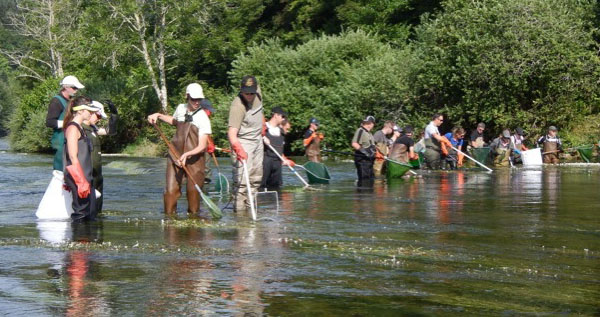
L’état de santé des édifices biologique est caractérisé en mesurant les biomasses ou/ et les densités des producteurs (algues et hydrophytes), et des consommateurs (macro-invertébrés et poissons) durant trois années successives (2014-2016). La répartition spatio-temporelle des insectes à larves aquatiques est étudiée très finement en s’attachant à la fois aux formes larvaires et aux imagos, déterminés et comptés à l’espèce.

Les impacts potentiels des rejets de stations d’épuration et leur variabilité spatio-temporelle sont étudiés à Pontarlier et à Ornans. Les études sur les transferts depuis les sols et dans le karst sont focalisées sur trois sous-bassins versants. Les sols sont cartographiés et leurs capacités de transferts sont caractérisées par des suivis. Les investigations concernant les contaminations portent sur les métaux lourds, les pesticides, les résidus médicamenteux, les HAP et d’autres polluants organiques persistants.
Elles sont réalisées sur quatre matrices : eau / MES / sédiments / tissus biologique.
[fr]Localisation des stations de mesure[en]Station locations
Partenariats
Les travaux sont financés par l’agence de l’eau RMC, le Conseil régional de Franche-Comté et le Conseil général du Doubs. Plusieurs partenaires, dont la Chambre interdépartementale d’agriculture du Doubs et du Territoire de Belfort, et AgroSup Dijon dans le cadre du PSDR Prosys, sont associés à certains aspects des travaux en cours.
Coordinateur: Eric Lucot
Chrono-environnement – Université de Franche-Comté
Voir aussi:
- 2012-2020 : Bilan d’étude sur l’état de santé des rivières karstiques
- Etude Paléo-Ecologique de la Loue (projet ZAAJ « LOUPE »)
- Un premier dispositif lysimétrique sur le bassin versant de la Loue…
- Détection de Saprolegnia parasitica…
[en]
Goals
The observatory is designed to lift the scientific barriers that prevent understanding the causes of the deterioration of the quality of karst water through the implementation of a transdisciplinary approach involving biologists, soil scientists, hydro-geologists and chemists, on several scales from laboratory to the field, and from aquatic habitat to the watershed.
issues
The observatory is divided into three themes:

- Research data, current and past observations and knowledge on the Loue and its watershed.
- Characterization of the health and evolution of biological structures of the river Loue (hydrophytes herbarium, algal communities, benthos and fish). Joint research of physical, physicochemical factors limiting the biogenic capacity of streams and determining the degree of chemical contamination.
- Identifying sources of contamination and disruption and transfer mechanisms in soils and karst throughout the watershed. The hydrogeological observatory Jurassic karst is involved in the study of transfers in the karst.
Location and temporality
The health of biological communities is characterized by measuring biomass and/ or densities of producers (algae and water plants) and consumers (macro-invertebrates and fish) for three successive years (2014-2016). The spatio-temporal distribution of larvae of aquatic insects is studied very finely with a focus on both larval forms and imagos, determined and counted to the species level.
The potential impacts of discharges from wastewater treatment plants and their spatial and temporal variability are studied in Pontarlier and Ornans. Studies on transfers from soils and karst focus on three sub-watersheds. The soils are mapped and transfers capacities are monitored. The investigations concern contamination of heavy metals, pesticides, drug residues, PAHs and other persistent organic pollutants. They are achieved on four matrices: water / MES / sediment / biological tissues.
[fr]Localisation des stations de mesure[en]Station locations
Partnerships
The work is funded by the RMC water agency, the Franche-Comté Regional Council and the General Council of the Doubs. Several partners, including the Interdepartmental Chamber of Agriculture of the Doubs and the Territoire de Belfort, , and AgroSup Dijon as part of the PSDR Prosys programme, are associated with certain aspects of the work in progress.
Coordinator: Eric Lucot
Chrono-Environment – University of Franche-Comté
Read more:
A first lysimetric set installed in the Loue watershed…
Saprolegnia parasitica detection…